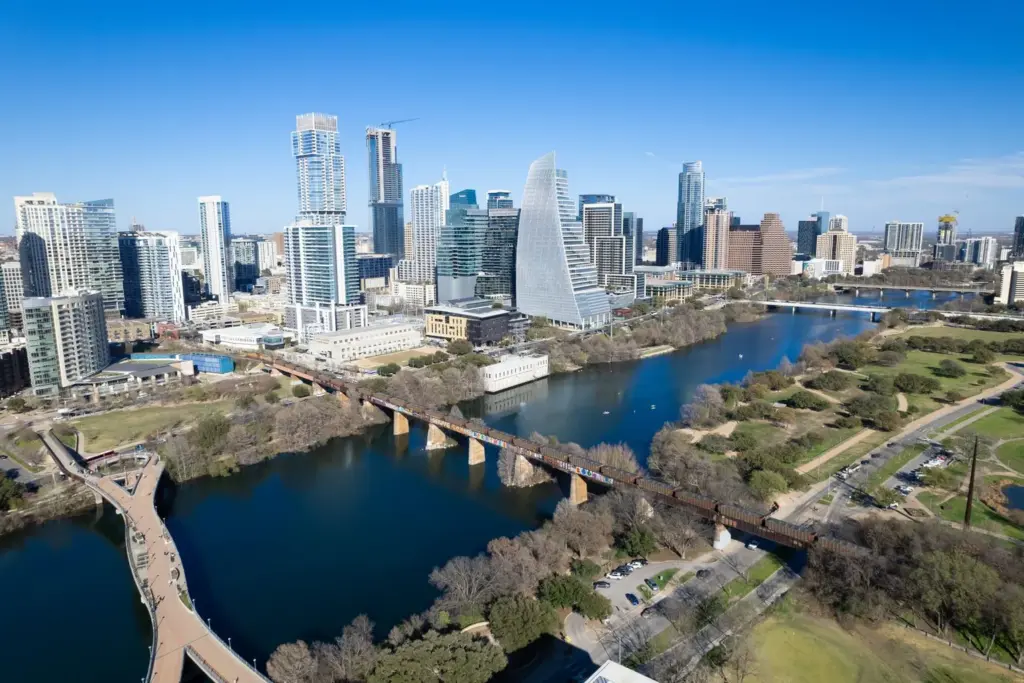
Where Austin Real Estate Stands in Mid-2026: The Numbers
Austin’s median home price sits at $440,000 across the metro area as of mid-2026, down roughly 20% from the May 2022 peak of $551,961 recorded by the Austin Board of Realtors. Within the city of Austin proper, the median runs closer to $595,000. Active listings have climbed to approximately 16,900 across the Austin-area MLS, one of the highest inventory counts this region has ever recorded, and about half of those listings have already taken at least one price cut.
That correction matters for anyone thinking about the next five years. Austin spent 2021 and early 2022 in a frenzy that pushed prices up roughly 40% in 18 months. The pullback that followed was not a collapse. It was a market recalibrating to sustainable levels after mortgage rates more than doubled, from 3% to nearly 7.5%.
The result is a balanced market. Months of supply hover between 4.7 and 5.9 depending on the data source, and 30-year fixed rates have eased to around 6.5%, down from 6.9% a year earlier. Sales volume is climbing: 2,819 homes closed in May 2026, up from 2,431 the previous May. The floor has formed. The question is what happens next.
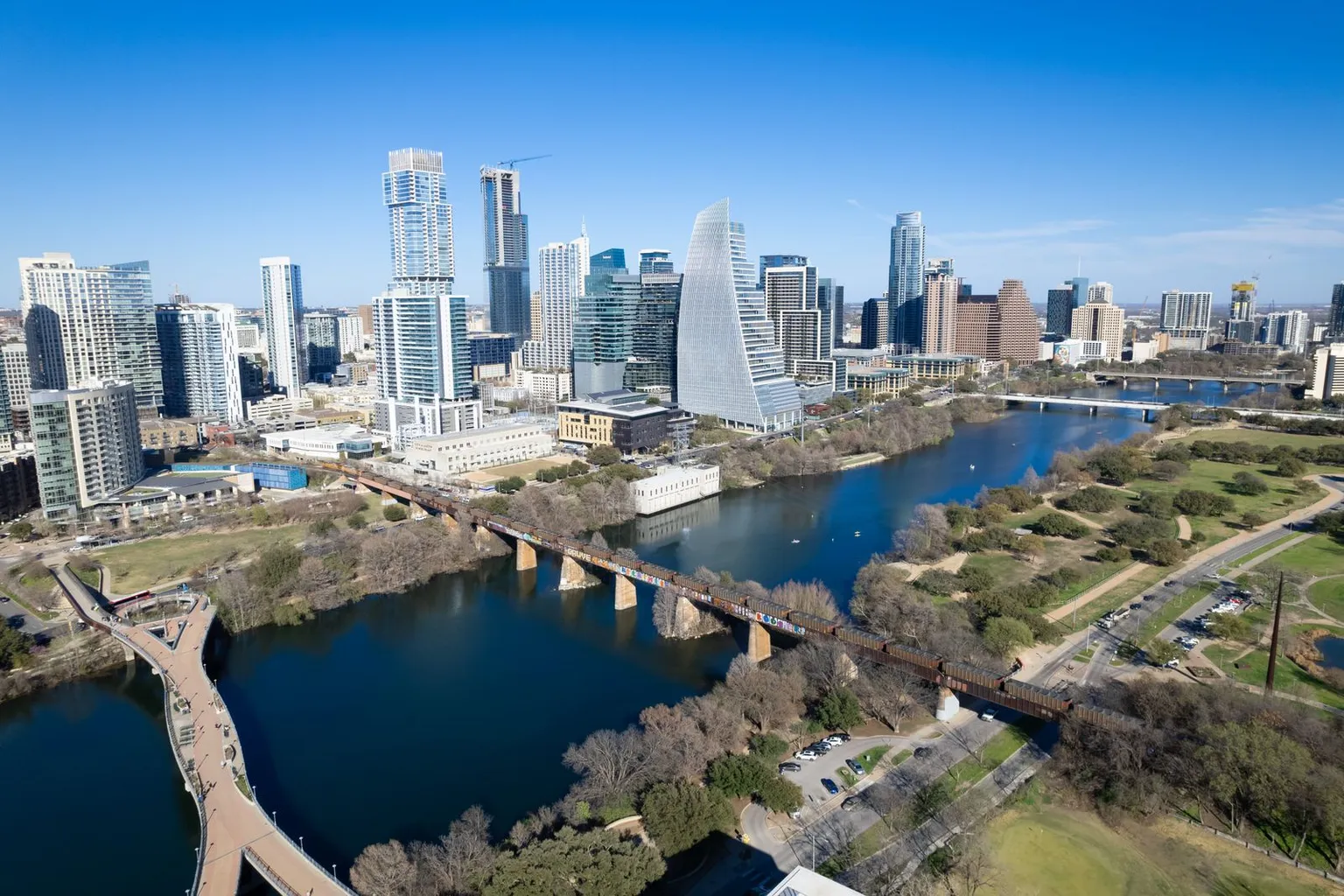
Population Growth: Austin’s Structural Tailwind
The Austin-Round Rock metro area has grown to approximately 2.6 million residents, according to U.S. Census Bureau estimates. Between 2020 and 2025, the metro ranked first among the nation’s 50 largest metropolitan areas for both population growth rate and net migration.
That translates to roughly 50,000 to 60,000 new residents per year. Put another way: Austin adds the equivalent of a mid-sized Texas city annually. The City of Austin’s Imagine Austin forecast projects the metro could reach 3 million by the end of this decade if current trends hold.
This growth is not accidental. Three forces drive it:
Jobs. Austin’s total nonfarm employment reached 1,428,000 in February 2026, up 2.5% year over year, according to the Bureau of Labor Statistics. The unemployment rate stands at 3.4%, well below the 4.1% national average. The region added 8,300 net new technology positions in 2026 alone, concentrated in AI infrastructure, semiconductor-adjacent software, and enterprise SaaS.
No state income tax. Texas charges zero state income tax, which means a household earning $200,000 keeps roughly $8,000 to $12,000 more per year compared to California, New York, or Colorado. That savings translates directly into home-buying power.
Quality of life at scale. Austin offers a combination of outdoor recreation, cultural amenities, dining, and climate that attracts relocators from both coasts and the Midwest. The metro now has four major hospital systems, multiple top-rated school districts, and expanding infrastructure.
For real estate, sustained population growth is the single most important variable. More people need more housing. Whether they buy or rent, they absorb inventory and support property values over time.
The Tech Economy: Jobs Driving Demand Through 2030
Austin’s tech sector has diversified beyond the software and cloud companies that defined its initial boom. The next five years will be shaped by three pillars: semiconductors, AI infrastructure, and advanced manufacturing.
Samsung’s $44 Billion Bet
Samsung’s semiconductor fabrication complex in Taylor, about 30 miles northeast of Austin, represents the largest foreign direct investment in Texas history. The facility secured $6.4 billion in federal CHIPS Act funding and is pivoting to advanced 2-nanometer chip technology, with production now targeted for late 2026 or 2027. When fully operational, the plant is expected to employ thousands of workers directly and support a broader ecosystem of suppliers, contractors, and service providers.
The ripple effects are already visible. Taylor and Hutto have seen new home construction accelerate, commercial development has followed, and the Williamson County tax base is expanding. The Samsung investment is a multi-decade commitment that anchors Austin’s semiconductor corridor alongside existing players like NXP Semiconductors, Infineon, and Texas Instruments.
Apple, Tesla, and Oracle
Apple’s North Austin campus now houses approximately 15,000 employees, making it one of the company’s largest operations outside Cupertino. Tesla employs more than 3,500 engineers and software specialists at Gigafactory Texas, alongside its 22,000-strong manufacturing workforce. Oracle maintains 3,000 to 4,200 employees at its Austin headquarters campus on East Riverside and has filed permits for a new office building plus a 255-room hotel.
Google, Meta, Indeed, Dell Technologies, and dozens of high-growth startups round out the employer base.
What This Means for Housing
Tech worker compensation drives demand in the $400,000 to $800,000 price range, which is exactly where most of Austin’s housing stock sits. The household income needed to buy the metro median home ($440,000 with 5% down at current rates) is roughly $130,000 to $145,000, according to calculations based on the 28% front-end DTI standard. Senior tech employees and dual-income households clear that threshold comfortably, while entry-level workers increasingly look to suburbs like Pflugerville, Round Rock, and Cedar Park.
The concentration of tech employers also provides a hedge against the kind of single-industry collapse that has hurt other markets. Austin’s tech base is spread across hardware, software, AI, clean energy, defense, and biotech.
Interest Rates and Affordability: The Math Through 2030
Mortgage rates will likely remain the single biggest variable in Austin’s housing market over the next five years. The 30-year fixed rate sits near 6.5% as of mid-2026, down from a cycle peak above 7.5% in late 2023.
| Rate Scenario | Monthly Payment ($440K, 5% Down) | Annual Income Needed | Impact on Demand |
|---|---|---|---|
| 7.0% | $2,780 | $148,000 | Constrains move-up buyers |
| 6.5% (current) | $2,644 | $141,000 | Balanced market |
| 6.0% | $2,508 | $134,000 | Unlocks sidelined buyers |
| 5.5% | $2,374 | $126,000 | Significant demand surge |
Every half-point drop in mortgage rates reduces the monthly payment on a median Austin home by roughly $135 and opens the market to thousands of additional qualified buyers. If rates drift toward 5.5% to 6.0% by 2028 or 2029, expect a measurable uptick in sales volume and price appreciation.
The flip side: if rates hold above 6.5% or climb back toward 7%, Austin’s price recovery will remain gradual. The “lock-in effect,” where existing homeowners with sub-4% mortgages refuse to sell, continues to constrain resale inventory even as new construction adds supply.
For first-time buyers, programs matter. The City of Austin offers down payment assistance up to $40,000 for qualifying purchasers, and the Texas State Affordable Housing Corporation (TSAHC) provides grants covering 3% to 5% of the purchase price that do not require repayment. These programs meaningfully lower the income threshold, especially for homes in the $300,000 to $400,000 range. See our Complete Guide to Down Payment Assistance in Austin for program details and income limits.
Housing Supply: What’s Being Built and Where
New construction permits remain elevated across the Austin metro, and the development pipeline tells a clear story about where the region is heading.
Suburban Expansion
The largest new-home communities are concentrated in Williamson County (Georgetown, Liberty Hill, Leander, Hutto, Taylor) and Hays County (Kyle, Buda, San Marcos, Dripping Springs). Master-planned communities from builders like Toll Brothers, Taylor Morrison, Perry Homes, Meritage, and KB Home continue to deliver homes in the $300,000 to $600,000 range, often with buyer incentives of $10,000 to $30,000. For more on builder incentives and the construction process, see our Complete Guide to New Construction Homes in Austin.
Multifamily and Mixed-Use
Austin’s apartment pipeline added thousands of units between 2023 and 2025, contributing to rising vacancy rates and softening rents. That supply wave is beginning to taper as developers pull back on new starts, which should stabilize the rental market by 2027 or 2028. Several major mixed-use projects are reshaping specific corridors, particularly along South Congress, East Riverside, and the Domain area.
ADU Expansion
Austin’s HOME Initiative allows up to two accessory dwelling units per single-family lot, with reduced minimum lot sizes (2,500 square feet) and a maximum ADU size of 1,100 square feet. This policy, adopted in phases during 2023 and 2024, is gradually increasing the housing supply within established neighborhoods. ADU construction in Austin runs $150 to $250 per square foot. Our Complete Guide to ADUs in Austin covers regulations, costs, and rental income potential.
The Supply-Demand Balance
Through 2030, the supply picture looks healthier than at any point in the past decade. Austin is no longer the supply-starved market that produced the 2021 frenzy. But population growth of 50,000-plus people per year will eventually absorb available inventory, especially if construction lending tightens or builder margins compress. The equilibrium point for Austin likely settles somewhere between 3.5 and 5.5 months of supply, supporting moderate (2% to 5%) annual appreciation rather than the double-digit swings of the pandemic era.
Project Connect: How Light Rail Will Reshape Property Values
Austin voters approved Project Connect in November 2020, creating the city’s first light rail system. Five years later, the project has evolved significantly.
The current plan calls for fewer than 10 miles of light rail with 15 stations (reduced from the original 26), at a cost of $8.2 billion, up from the initial estimate of $5.8 billion. The route no longer reaches Austin-Bergstrom International Airport. Construction contracts were approved in the first half of 2026, with groundbreaking expected in 2027 and passenger service projected for 2033, according to the Austin Transit Partnership.
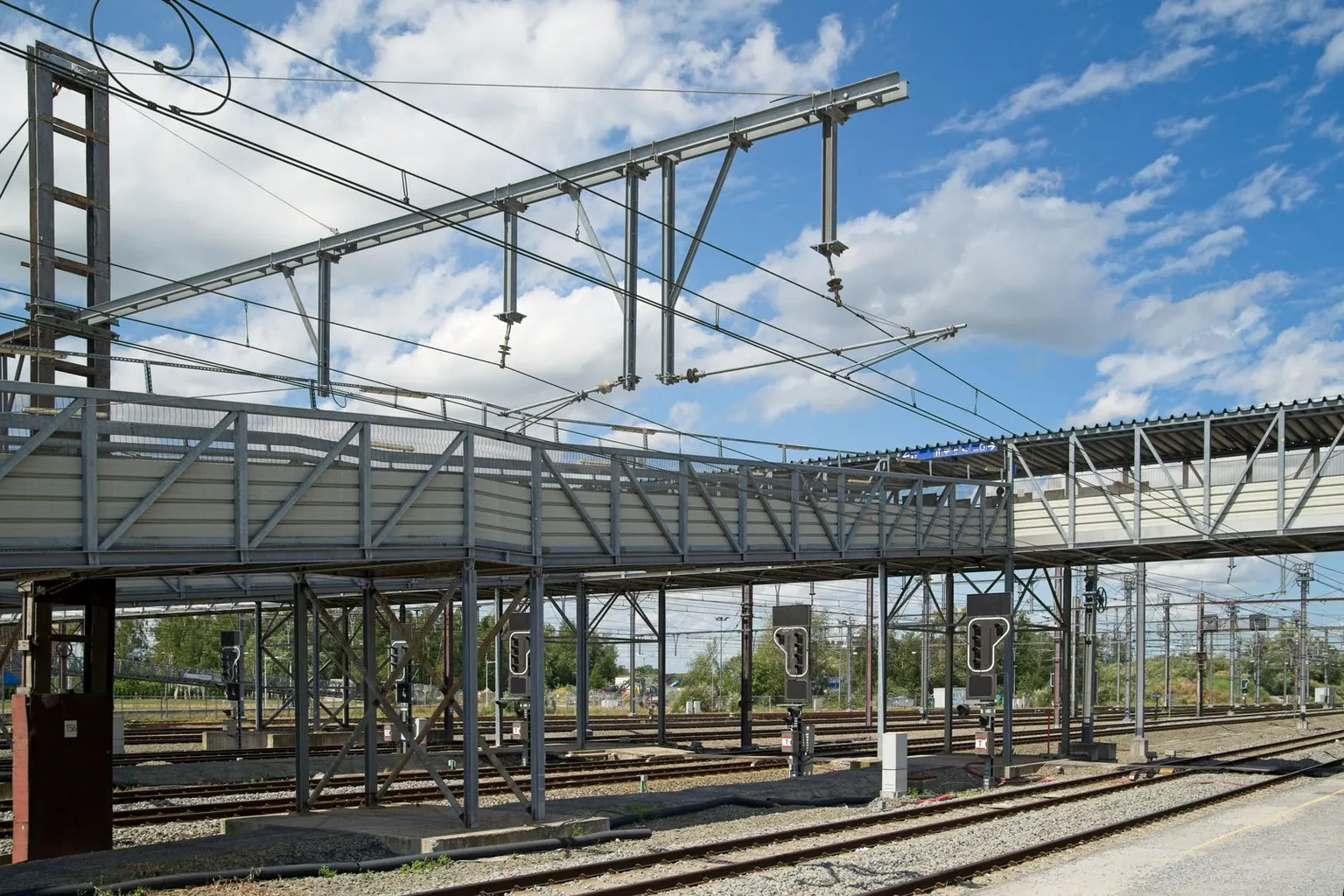
The Property Value Question
Research on light rail’s impact on property values is extensive. The general finding, documented across cities from Portland to Denver to Dallas, is that properties within a half-mile of transit stations appreciate 10% to 25% more than comparable properties farther away, with the strongest gains occurring in the two to three years before a station opens.
In Austin, the stations most likely to see meaningful value impact include:
- South Congress and Stassney Lane: These corridors already have strong walkability and commercial appeal. Light rail access amplifies their attractiveness.
- East Riverside: Already undergoing massive redevelopment, transit access could accelerate the area’s transformation into a dense urban district.
- North Lamar: Transit stations along this corridor could catalyze redevelopment of aging strip commercial properties.
The tradeoff: Project Connect created a permanent property tax increase of roughly 8.75 cents per $100 of assessed value. On a home assessed at $500,000, that adds about $437 per year. For investors evaluating long-term returns, the question is whether station-area appreciation will exceed the cumulative tax cost. History suggests it will, but the timeline is 7 to 10 years, not 2 to 3.
For a detailed look at how city planning affects property values, see The Impact of Future City Planning on Property Values.
I-35: The $5 Billion Rebuild That Will Take a Decade
TxDOT’s I-35 Capital Express project is the largest highway reconstruction in Texas history. The three-segment overhaul, spanning North, Central, and South Austin, carries a combined price tag exceeding $5 billion and will take approximately a decade to complete.
Current Progress (2026)
Capital Express North: Frontage roads are being widened to three lanes. Bridge deck construction is complete at Rundberg Lane, Wells Branch Parkway, and Grand Avenue Parkway.
Capital Express Central: The $4.5 billion centerpiece of the project. Tunnel boring machines are arriving in 2026 for flood mitigation work. The MLK Jr. Bridge is being demolished and rebuilt. This segment will depress I-35 through downtown, creating a boulevard-style surface street above.
Capital Express South: Elevated managed lanes are under construction, with dozens of bent caps and support columns completed. Beam installation is underway over the Stassney Lane Bridge.
Real Estate Implications
The construction period (2026 through approximately 2035) will create significant disruption along the I-35 corridor. Properties within a quarter-mile of active construction zones will experience noise, dust, and access challenges. Historically, properties near major highway reconstruction projects see temporary value depression of 5% to 10% during peak construction, followed by recovery and gains once the project completes.
The completed I-35 will remove the physical barrier that has divided East and West Austin for decades. The depressed highway through downtown, capped with parkland and pedestrian connections, could create substantial value in adjacent neighborhoods, particularly East Austin. Think of what the Big Dig did for Boston’s waterfront or what the removal of the Embarcadero Freeway did for San Francisco.
Water: Austin’s Growth Ceiling
Water is the constraint that most newcomers overlook and most forecasters underweight.
Austin has been under Stage 2 drought restrictions since July 2025, targeting a 10% to 20% reduction in citywide water use. The city draws its water primarily from Lakes Travis and Buchanan, the Highland Lakes system managed by the Lower Colorado River Authority (LCRA). Those levels fluctuate dramatically based on rainfall in the Colorado River watershed west of Austin.
The deeper issue is structural. A Texas 2036 assessment estimates that without a diversified water supply portfolio, annual economic losses from prolonged drought could reach $160 billion by 2030 across the state. Texas loses approximately 88 billion gallons annually to aging and leaking pipes alone, enough to serve hundreds of thousands of households.
For homeowners and investors, water constraints affect real estate in several ways:
- Landscaping costs. Drought restrictions limit outdoor watering, pushing homeowners toward xeriscaping and native plantings. Properties with established drought-tolerant landscapes hold value better during restrictions.
- Development limits. New subdivisions require water capacity commitments. Some Hill Country communities have already paused development approvals during drought conditions.
- Well and septic properties. Rural and semi-rural properties on wells face Edwards Aquifer regulations and groundwater conservation district rules. See our Complete Guide to Well Water and Septic in the Hill Country.
- MUD bonds. Municipal utility districts fund water infrastructure through bonds, adding to property tax bills. Our Complete Guide to MUDs and PIDs explains how these costs work.
Austin Water is investing in reclaimed water systems, aquifer storage and recovery, and pipeline infrastructure. These projects will take years to complete, but they represent a long-term solution. The takeaway for the 2026-2030 window: water will not halt Austin’s growth, but it will increasingly shape where and how fast new development occurs.
Climate Adaptation: Building for the Next 50 Years
Central Texas weather is getting more extreme. Austin averages 10 to 15 days above 100 degrees annually, but that count is trending upward. The July 4, 2025 flash flooding across Texas killed more than 130 people, a stark reminder that “Flash Flood Alley” is not a marketing term.
For real estate through 2030, climate shapes value in measurable ways:
Hail. Austin experiences 4 to 6 significant hail events per year. A Class 4 impact-resistant roof costs 15% to 25% more than standard composition but earns a 15% to 28% discount on homeowners insurance premiums. Over a 15-year roof life, the insurance savings typically exceed the upgrade cost.
Grid reliability. The February 2021 Winter Storm Uri exposed ERCOT’s vulnerabilities. Since then, Texas has added 14 GW of battery storage capacity, and the grid survived the January 2026 cold snap without major outages. Homes with backup power (whole-house generators or battery systems like Tesla Powerwall) command a premium, particularly in the Hill Country where outages last longer.
Flood zones. Properties in FEMA-designated Special Flood Hazard Areas require flood insurance and face lending restrictions. Austin’s adoption of the 500-year floodplain for development regulations (since NOAA Atlas 14 in 2019) provides stronger protection than most Texas cities. See our Complete Guide to Flood Zones and Flood Insurance in Austin.
Ed Neuhaus, broker of Neuhaus Realty Group, notes that buyers are increasingly asking about ERCOT resilience, hail history, and flood zone status before making offers. “Five years ago, those questions came up after the inspection. Now they’re part of the initial search criteria.”
Our Complete Guide to Disaster Preparedness for Austin Homeowners covers storm preparation, generator options, and insurance strategies.
AI and PropTech: Technology Reshaping How Real Estate Works
The real estate industry is in the early stages of an AI-driven transformation that will accelerate through 2030. The numbers are striking: the global AI-in-real-estate market reached $303 billion in 2025 and is projected to grow to $989 billion by 2029, a compound annual growth rate of 34.4%, according to market research firm Mordor Intelligence.
What’s Already Changing
Automated valuation models (AVMs) now achieve a median error rate of 2.8%, down from 10% to 15% five years ago. These tools do not replace professional appraisals for lending purposes, but they give buyers, sellers, and investors near-instant pricing data that is increasingly accurate.
AI-powered property management has reached a tipping point. Adoption among property management companies jumped from 20% to 58% in a single year. Agentic AI systems now handle tenant onboarding, lease analysis, maintenance scheduling, and rent optimization with minimal human oversight.
PropTech investment hit $16.7 billion globally in 2025, a 67.9% year-over-year increase that surpassed pre-pandemic funding levels. AI-native proptech companies are growing at a 42% annualized rate, compared to 24% for non-AI proptech firms.
What’s Coming by 2030
- Predictive pricing: Machine learning models will forecast neighborhood-level appreciation with increasing accuracy, allowing buyers and investors to identify value before it materializes.
- Automated underwriting: Mortgage approvals that currently take 30 to 45 days will compress to days or hours for straightforward applications.
- Digital twins: 3D models of properties and entire neighborhoods will enable virtual tours, renovation planning, and energy modeling before a buyer sets foot in a home.
- Smart contracts: Blockchain-based transaction platforms could reduce closing timelines and costs, though regulatory adoption in Texas remains uncertain.
For a broader look at how technology is reshaping the industry, see The Future of Real Estate: How AI Is Changing the Market.
Remote Work: The Geography of Value Has Shifted
The pandemic permanently altered where people work, and that shift continues to reshape Austin’s housing market. According to the Bureau of Labor Statistics, approximately 28% of workdays nationally are now performed remotely, and that figure is higher in tech-heavy metros like Austin.
For real estate through 2030, remote work means:
Suburban and Hill Country properties retain their pandemic-era appeal. Buyers who work from home two to four days per week prioritize space, outdoor access, and quiet over commute time. Communities like Dripping Springs, Bee Cave, and Lakeway continue to attract remote workers who want Hill Country living with occasional trips to an Austin office. See our Complete Guide to Working from Home in Austin.
Home office features matter. A dedicated office with a door, strong internet connectivity (AT&T Fiber, Google Fiber, Spectrum), and good natural light adds tangible value. ADUs configured as home offices are increasingly popular.
The Domain and suburban employment centers gain importance. As companies distribute offices across the metro (not just downtown), neighborhoods near secondary employment hubs like The Domain, Tech Ridge, and the 45/130 corridor benefit from proximity without downtown congestion.
Neighborhoods to Watch Through 2030
Not every Austin neighborhood will appreciate at the same rate. Here are the areas with the strongest structural tailwinds for the next five years.
| Neighborhood/Area | 2026 Median Price | Key Catalyst | Risk Factor |
|---|---|---|---|
| East Austin (78702/78721) | $500K-$650K | I-35 cap, transit, cultural cachet | Gentrification pushback, construction disruption |
| South Congress Corridor | $550K-$750K | Light rail station, walkability | Project Connect construction timeline |
| Taylor/Hutto | $300K-$400K | Samsung fab, new infrastructure | Production delays, single-employer risk |
| Georgetown | $350K-$450K | Population growth, Sun City retirees, schools | Water supply constraints |
| Manor/Elgin | $275K-$375K | Affordability, eastern growth corridor | Infrastructure lag, school ratings |
| Dripping Springs | $500K-$700K | Hill Country lifestyle, Eanes/DSISD schools | Water, septic requirements, traffic on 290 |
| Bastrop | $275K-$375K | Lifestyle destination, USDA-eligible areas | Commute time, limited employment base |
| East Riverside | $350K-$500K | Oracle campus, transit, density | Construction disruption, parking loss |
For a comprehensive neighborhood-by-neighborhood breakdown, see our Complete Guide to Austin Neighborhoods by Lifestyle.
The Investment Outlook: Where the Numbers Work Through 2030
Austin’s real estate investment landscape has shifted from the “buy anything and win” environment of 2020-2022 to a market that rewards analysis and discipline.
Long-Term Rental Properties
Cap rates in Austin have improved from the sub-4% levels of the pandemic era to 5% to 7% in many suburban submarkets. Properties in Pflugerville, Round Rock, Manor, and Kyle can generate positive cash flow at current prices and rents, particularly with 20% to 25% down. Our Complete Guide to Investment Property in Austin covers the full analysis.
Short-Term Rentals
Austin’s STR regulations tightened significantly on September 11, 2025, with platform enforcement beginning July 1, 2026. Type 2 (non-owner-occupied residential) STRs are being phased out, pushing investors toward Hill Country communities like Dripping Springs, Wimberley, and Fredericksburg where regulations are more favorable. See our Complete Guide to Airbnb and STR Investing in Austin.
Land
Raw land in the Hill Country and eastern Williamson County offers long-term appreciation potential, though financing is more challenging (30% to 50% down, higher rates) and carrying costs include property taxes on the land value. Agricultural exemptions can reduce the tax burden significantly. Our Complete Guide to Buying Land in the Hill Country covers ag exemptions, water rights, and due diligence.
The 2026-2030 Investment Thesis
Most analysts project low-single-digit appreciation (2% to 4%) through 2027, with the potential for acceleration to 5% to 7% annual gains by 2028 or 2029 if mortgage rates decline and population growth remains strong. On a $440,000 property purchased in 2026, that math looks like this:
| Year | Conservative (2% Annual) | Moderate (4% Annual) | Optimistic (6% Annual) |
|---|---|---|---|
| 2027 | $448,800 | $457,600 | $466,400 |
| 2028 | $457,776 | $475,904 | $494,384 |
| 2029 | $466,932 | $494,940 | $524,047 |
| 2030 | $476,270 | $514,738 | $555,490 |
Even in the conservative scenario, a buyer who purchases at $440,000 with 5% down ($22,000) and sees 2% annual appreciation gains $36,270 in equity from appreciation alone over four years, plus roughly $8,500 in principal paydown. That is a 203% return on the down payment.
Five Risks That Could Slow Austin’s Growth
No forecast is complete without examining what could go wrong. These are the five risks worth watching through 2030.
1. A tech recession. Austin’s economy is diversified but still tech-heavy. A significant downturn in the technology sector, whether from an AI bubble correction, tighter corporate spending, or geopolitical disruption, would reduce housing demand from the highest-income buyer segment. The Samsung Taylor fab production timeline has already slipped once; further delays would slow the eastern growth corridor.
2. Interest rates stay elevated. If inflation proves stickier than expected and the Federal Reserve holds rates at current levels through 2028 or beyond, Austin’s price recovery will remain sluggish. The “lock-in effect” would intensify, keeping existing homeowners in place and constraining move-up activity.
3. Water supply crises. A multi-year drought that drops Highland Lakes to critical levels could trigger Stage 4 or Stage 5 restrictions, halting new development and reducing the appeal of Central Texas living. Pflugerville’s March 2026 Stage 3 emergency declaration, the city’s first ever, was an early warning signal.
4. ERCOT grid failure. Another Winter Storm Uri-scale event that overwhelms the power grid would damage Austin’s reputation as a safe relocation destination. Texas has invested heavily in grid hardening (14 GW of battery storage since 2021, mandatory weatherization for generators), but the risk is not zero.
5. Political and regulatory shifts. Changes in property tax policy, zoning regulations, or STR enforcement could shift the investment calculus. The Texas Legislature has debated property tax elimination (replacing it with a consumption tax), which would fundamentally alter housing economics. HOA and deed restriction disputes also create localized risk. See our Complete Guide to HOA Disputes and Your Rights in Texas.
Price Forecast: What the Data Suggests for 2026 Through 2030
Based on the convergence of population growth, job creation, housing supply, interest rate trajectories, and infrastructure investment, here is a data-informed outlook for Austin real estate prices through 2030.
2026-2027: Stabilization and Grinding Recovery
Prices are expected to remain roughly flat to up 2% to 4% annually. Inventory will stay elevated by historical standards, keeping sellers honest on pricing. Well-priced homes in desirable locations will sell within weeks; overpriced or dated properties will sit for months. The buyer’s market conditions that have prevailed since late 2022 will gradually shift toward balance.
2028-2029: Potential Acceleration
If mortgage rates dip below 6%, the combination of pent-up demand (from the lock-in effect unlocking), continued population growth, and tightening new-construction starts could push appreciation into the 5% to 7% range. Project Connect construction will be visibly transforming corridors along the route, and station-area properties should begin to command premiums.
2030: The New Normal
By 2030, Austin will likely have a metro population exceeding 3 million. The completed segments of I-35 Capital Express will begin to reshape connectivity. Project Connect will be within a few years of opening. The housing market will have fully absorbed the 2022 correction, and median prices should exceed the previous peak, potentially reaching $500,000 to $550,000 at the metro level.
This is not a prediction of exponential growth. It is an expectation of steady, compound appreciation driven by fundamental demand, the kind that builds generational wealth for homeowners who buy and hold.
Ed Neuhaus of Neuhaus Realty Group puts it simply: “Austin’s next five years will reward patience more than timing. The people who bought in 2026 and held will look smart by 2030, regardless of whether they bought in January or July.”
Austin vs. Other Sun Belt Markets
Austin does not exist in a vacuum. Buyers and investors considering the Austin market through 2030 should understand how it compares to competing Sun Belt metros.
| Metro | 2026 Median Price | Population Growth Rate | State Income Tax | Key Advantage |
|---|---|---|---|---|
| Austin, TX | $440,000 | ~2.0% | None | Tech jobs, culture, outdoor lifestyle |
| Dallas-Fort Worth | $385,000 | ~1.5% | None | Corporate HQs, affordability, scale |
| Nashville, TN | $430,000 | ~1.3% | None | Healthcare, music, tourism |
| Raleigh, NC | $415,000 | ~1.8% | 4.5% | Research Triangle, universities |
| Phoenix, AZ | $430,000 | ~1.4% | 2.5% | Semiconductors, affordable suburbs |
| Tampa, FL | $380,000 | ~1.2% | None | Beach access, no income tax |
Austin’s combination of no state income tax, strong job growth, quality of life, and infrastructure investment positions it competitively within this peer group. The price correction from 2022 peaks has also brought Austin closer to affordability parity with markets like Nashville and Phoenix that were previously cheaper.
For detailed comparisons with specific cities, see our city-by-city moving guides: California to Austin, New York to Austin, Chicago to Austin, and Denver to Austin.
Frequently Asked Questions
What This Means for Your Next Move
Austin’s real estate market from 2026 through 2030 will not look like the frenzy of 2021 or the correction of 2023. It will look like a market returning to fundamentals: steady population growth, diversified job creation, improving infrastructure, and moderate price appreciation.
For buyers, the current window offers a combination of elevated inventory, negotiable prices, and the beginning of a rate decline cycle. Waiting for the “perfect” time to buy is a strategy that has historically underperformed buying and holding in a growing metro.
For sellers, pricing accurately from day one matters more than it has in a decade. The days of listing high and waiting for a bidding war are over for now. Properties that are well-maintained, properly staged, and priced at market value still sell quickly.
For investors, discipline beats speculation. Cash-flowing rental properties in suburban growth corridors, land in the path of development, and station-area properties along the Project Connect route all offer defensible long-term returns.
Austin’s story from 2026 to 2030 will be written by infrastructure investments (Project Connect, I-35, water systems), by the tech economy (Samsung, Apple, Tesla, AI startups), and by the continued migration of people seeking opportunity in a state with no income tax and a high quality of life.
For buyers and investors exploring the Austin market, our full library of 100 comprehensive guides covers every aspect of buying, selling, and living in Austin and the Texas Hill Country. Start with our Complete Guide to First-Time Homebuying in Austin or Complete Guide to Choosing a Real Estate Agent.
For market-specific questions about buying, selling, or investing in Austin real estate, reach out to the team at Neuhaus Realty Group.